Search Results: b (2704)

Letters Honore-Daumier_the-players
19

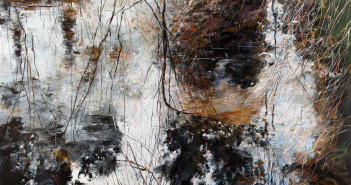
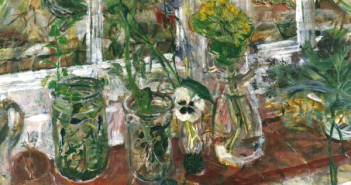
Visible instincts are personal items that bring magic and specificity to your paintings and, with practice, appear automatically. They’re at times universal and technical, but can be poetic or even self-honed nothings, unique to you and your brush. Your list is one-of-a-kind, and you’re probably already working it:

Grey to neutralize — a rest for the eye
Large and/or interlocking gradations — to catch the eye
Warm colours against cool
Strong value contrast
Letters 010915_gordon-smith
37

I recently visited a new-to-me forest near my home. Sycamore and oak leaves draped yellow and orange over a black pond. I stood barefoot and let November swirl around my ankles. In the dusk, I found a nest inside a fallen tree trunk that reached over the lake. I took it as an invitation to embrace nature’s coming sleep.

In Japanese art, the term wabi-sabi revolves around an idea: nothing is perfect, nothing is permanent, and nothing is finished. Intuitively, we sense that things are most beautiful when they begin to wither

Letters olwyn-bowey_still-life-with-a-thrush
17

A question I’ve been asked is, “What is often a problem for me is choosing subject matter. How do you go about it? Is it because you are often inspired by what you see?”

It’s interesting to note that many of us simply “feel a painting coming on.” Subject matter can be almost secondary when you feel the urge. Relegated to a minor role, “It’s not what you do, it’s how you do it.” But by and large we generally start with “something.” My experience has been that professionals have to learn how to get gold from all of their mines:

Letters cuban-art_Santiago-Rodriguez-Olazabal
42

A bus sits idling and cannot find its driver. A few ancient automobiles avoid the potholes. Workers shuffle. The hotel rooms are not yet ready and, when they are, there are no towels. When the coffee comes, it’s cold and it’s not coffee. The Cuban government has a hand in every enterprise — every farm, garden, store, hotel, factory and art gallery. Commercial galleries are few and far between. In this island of 11 million, a handful of chosen artists are the ones who are recognized, get the press and are hung in the public galleries.

Letters banksy
9

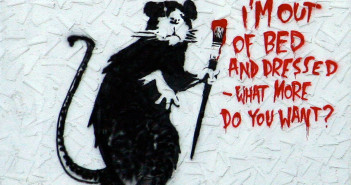
Here on Kauai there are a lot of people with “Tommy” written on their clothing. When you think of “branding,” names like Coke, Nike and Marlborough also come to mind. A long way from the world of art. Art has integrity, uniqueness, we like to think. It’s perhaps surprising that people would walk around advertising Tommy Hilfiger — the guy that actually took their money for the duds. Then again, we artists do something similar:

Letters kristen-dukat11
37

Yesterday, I received an email: “I began my journey at the University of Toledo in Fine Art. Lacking confidence, I switched to Art Education. I felt I couldn’t take the rejection from galleries and shows and what it takes to be a real artist. I just wanted to paint beautiful things — I wasn’t looking for angst or meaning or whatever it is that the experts say makes art. I actually won a scholarship for ‘student with the most promising portfolio’ but, nevertheless, my work wasn’t accepted into the annual student show. I was defeated. I didn’t pick up a brush for seven years

Letters fiona-rae_hope
35

Having heard from many of you with juror experience, a theme has emerged around the very basics for artists submitting to a juried show. While one regular juror may hinge all on technical merit and another cruises for signs of imagination, a few fundamentals stand out as universal. They’re so simple they serve as a gentle reminder for anyone at any stage of the submission game:

As well as providing important archival protection, most paintings benefit visually from a coat of final varnish. For acrylics, this means UVLS varnish cut 50/50 with water and brushed on or poured and then wiped off with a lint-free rag

Letters john-singer-sargent1000x574
10

The next time you have one of the instruments of your craft in your hand, take a minute to see exactly what it is, and try to rethink what it’s best cut out to do. Paint brushes are often asked to do things they were not meant to do. Whether from laziness or ignorance, the wrong sizes and shapes are pressed into service. Large passages are laboured through with little brushes, while detail is attempted with big ones. This is often because artists have their eyes on reality and not on illusion.

1 13 14 15 16 17 271