Search Results: g (2707)

Letters delaunay-jules_sappho
20

Upon analyzing more than six decades of creativity-related papers, English scholars have isolated some recurring themes. Kent University computational scientist Anna Jordanous and Sussex University linguist Bill Keller suggest that fourteen interdependent components can be identified as the building blocks of creativity. As artists, we know them collectively as “the Muse” and, at the risk of spoiling our mystery, here they are:
Letters sara-genn_early-work2
29

Rolf Reichert of North Vancouver, B.C. wrote, “I am a hobby artist and would like to exhibit my art work at sometime or another, but don’t know what I should price it at. I don’t expect a fortune for my work, but maybe just my material cost and a little profit for my time would be fair. Is there a formula that I could follow to take the guesswork out of my head? Or should I look at other artists’ paintings and gauge mine from there? If you could give me a rough idea how I could go about pricing my paintings, I would be grateful.”

Letters ernst-ludwig-kirchner
22

These days there’s a growth industry in what has been called the “modern epidemic.” Stress-related disorders affect 80% of the population. Funny, you’d think that there might have been more stress in the old days when folks were regularly eaten by wolves. Apparently not. Nowadays we are cooking up our own stress. “Stress is the body’s automatic default reaction to perceived threat,” says stress management guru Eli Bay. His Relaxation Response Institute in Toronto, Canada, offers deep breathing, nose-breathing focus, positive affirmations and other techniques to bring the body and mind into a state of calm. “You don’t have to believe in it,” says Bay, “You just have to do it. What’s real is what you experience.” Eli and other therapists offer what sounds like an artist’s wish list: More energy, calmer disposition, more control, clearer thinking, improved memory, increased productivity, enhanced creativity.

Letters peter-schmidt_flowing-in-the-right-direction
18

Acting on a tip, I downloaded from the app store a deck of imagination prompts. Originally created in 1975 by musician Brian Eno and painter Peter Schmidt, Oblique Strategies began as a box of index-sized cards for artists, made of cut up, discarded prints from Schmidt’s studio. Now, in 2016, the cards can arrive on your phone. I found them by following the breadcrumbs from a story in the New Yorker magazine describing a world-renowned food critic who sometimes emails his editor around deadline time to say that he’s forgotten how to write. For him, Eno and Schmidt’s “strategies” have been a go-to during moments of creative malaise. But what about deadlocks at the easel? The “strategies” include:

Letters the-eishin-campas-cafeteria
13

Architectural visionary Christopher Alexander has produced a four-volume “essay” that attempts to cure architecture. The Nature of Order: the Art of Building and the Nature of the Universe makes some valuable assertions. Apart from being interested in the “universals” that he thinks ought to apply to buildings, I was playing with the idea of applying his principles to art in general and painting in particular:

Letters marina-abramovic_artist-is-present
10

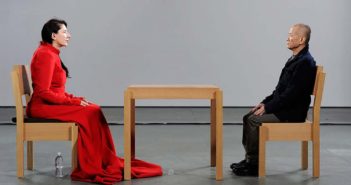
In post-war Belgrade, Marina Abramovic’s parents were war heroes, having fought against the Nazis with the Yugoslav partisans and been rewarded with positions in the Communist party. Marina’s father was part of Marshal Tito’s elite guard, her mother director of the Museum of Art and Revolution. Her family of four lived in a larger-than-usual apartment and Marina had few responsibilities other than to do well in school.

Letters scott-adams_dilbert2
7

A few years ago while working, Scott Adams felt a spasm in the pinky finger of his drawing hand. He was diagnosed with focal dystonia — a neurological disorder where misfiring neurons in the brain cause unwelcome contractions in task-specific muscles. Musicians call it “musician’s dystonia”; archers “target panic”; and, in other sports, it’s called the “yips.” While the causes aren’t well understood, it’s thought to come from excessive overuse of fine motor muscles, and doctors say it’s incurable.

Letters Joan-Mitchell-1953
19

London art lecturer and freelance critic Estelle Lovatt posted her son’s abstracts on Saatchi Art, wondering if the art world would encourage an unknown artist. On the site, she described him as a person devoted to art, who frequented major exhibitions and who’d steadily progressed in his influences and techniques, including drawing from nature, plein air, mid-century American Abstract Expressionism and Japanese calligraphy. She also mentioned that her son’s paintings had evolved to employ more archival materials, like acrylic, following a period where he’d worked almost exclusively in tomato ketchup.

Letters pablo-picasso_dancing-in-his-studio
18

Physicians are at odds regarding the possible dangers to the still-forming skeletons of young gymnasts. Until 1981, the minimum age to compete in senior events — including the Olympics — was 14. By 1997 the requirement had been raised to 16, with experts arguing that intense practice at the elite level was too hard on developing bodies, causing hormonal imbalance and putting unsustainable strain on prepubescent bones. Other studies, however, have suggested that younger gymnasts may have a physical and psychological advantage over their elders.

Letters edgar-payne_Breton-tuna-boats-at-anchor
26

A subscriber wrote, “I grew up in an environment that did not stimulate creative development. Nevertheless, in adolescence I was a prolific writer. But suddenly I stopped. I remember thinking that what I wrote wasn’t any good, and that I shouldn’t write any more. I put everything I wrote into the garbage. I don’t know why. Now ten years have passed and I haven’t written anything. What I find curious is that I still remember the pleasure the writing gave me, and being frequently in a state of ‘flow.’ I would like to recapture that same pleasure, the creativity that I had, and begin writing again. I don’t know exactly where to start and don’t have a clue if I’m on the right path. Any suggestions or advice?”

1 21 22 23 24 25 271