Search Results: g (2707)

Letters Edouard-manet_In-the-Conservatory
10

After a one-person show a kind of post-partum psychosis sets in, which generally lasts for a day or so, then, for some reason, there’s a need to go back to work. Looking for the secret at the easel, I remembered: “It’s a matter of thinking one thing while you’re thinking of other things.” A modest understanding, but it’s useful. Often we merely push on — leaving the work to evolve in the hands of the gods — very much as a potter surrenders his clay to the “Kiln God.” Sure, there’s a place for intuition and just letting flow — but there’s also a need to bring in all of the strategy we can muster.
Letters Philippe-Petit
12

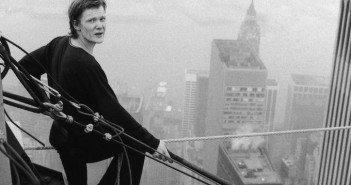
On the morning of August 9, 1974, French high-wire artist Philippe Petit rigged a 450-pound cable between the Twin Towers of the World Trade Center and for 45 minutes walked, danced, lay down, kneeled and saluted, 1350 feet above an impromptu crowd in the plaza below. Because he believed that all great creative acts are a kind of rebellion, Philippe called his unauthorized walk “the coup.” After being arrested, released and sentenced to perform for children in Central Park, Philippe celebrated his 25th birthday and made New York his home.

Letters robb-dunfield3
16

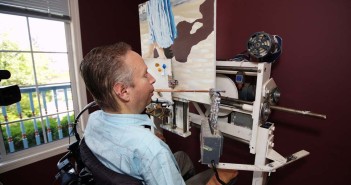
Robb Dunfield was an active nineteen year old sportsman, ski instructor, and all round good chap when he had his accident. He and three of his friends plunged from an insecure balcony of an unfinished building. Robb received irreversible injuries — a severed spine.

Robb was confined to a quadriplegic hospital, paralyzed from the neck down. For years he lay there, a ventilator doing his breathing, at times without even his voice, a ward of the state and a source of anguish for his family. One day he told me he wanted to learn to paint.

Letters 080712_robert-genn4
30

Painting techniques are easily adapted for oil and watercolour, but fast pleasure is found by going for them in acrylic. Speedy drying times and the knowledge that mistakes can be covered up in an instant keep the process uncommitted and playful. Here are five that enliven the act of painting and are generous with surprises:

Gradation
My second-year painting prof called them “suckerblends,” which I took to mean that they snuck into your heart and made you love them forever, like a sucker. There was a time when many painters believed that a smooth gradation was impossible in fast-drying acrylic.

Letters kristen-dukat11
37

Yesterday, I received an email: “I began my journey at the University of Toledo in Fine Art. Lacking confidence, I switched to Art Education. I felt I couldn’t take the rejection from galleries and shows and what it takes to be a real artist. I just wanted to paint beautiful things — I wasn’t looking for angst or meaning or whatever it is that the experts say makes art. I actually won a scholarship for ‘student with the most promising portfolio’ but, nevertheless, my work wasn’t accepted into the annual student show. I was defeated. I didn’t pick up a brush for seven years

Letters fiona-rae_hope
35

Having heard from many of you with juror experience, a theme has emerged around the very basics for artists submitting to a juried show. While one regular juror may hinge all on technical merit and another cruises for signs of imagination, a few fundamentals stand out as universal. They’re so simple they serve as a gentle reminder for anyone at any stage of the submission game:

As well as providing important archival protection, most paintings benefit visually from a coat of final varnish. For acrylics, this means UVLS varnish cut 50/50 with water and brushed on or poured and then wiped off with a lint-free rag

Letters Wood-Bike-and-Trailer-Poletz
23

Last Monday a museum curator, a watercolourist and I met in a community centre to jury a show for the local arts council. While most were paintings, the entries also included sculptures, pastels, drawings, ceramics, fiber arts, papier mache and works in collage, printmaking, woodworking, metalwork and batik. There was silver and goldsmithing, felting, glass, quilts and mediums called “joining compound” and “scratch art.” And there were photos: digital and film, composites and painted, with prints on metal, plastic, fabric, canvas and watercolour paper. Everything had been made within the last two years — a miracle of productivity. We had but one day to cull eleven hundred entries to a third.

Letters mark-adams4
13

“With our calculated sensitivity we artists are able to see and to some degree reproduce nuances that others may know of but not be able to express. That’s why we’re so highly paid.” Every once in a while, in a workshop or a speech, I mention something like the above. Funnily, this line always gets a laugh. Artists roll their eyes and think, “Oh yeah — highly paid — who does he think he’s kidding.” I’ve never thought I was kidding.

Letters dianna-poindexter_painting-Levi-Leisha
10

My studio is now silent. Visitors have evaporated to their own spaces. It’s late at night. The brush dashes here and there. Is it habit, addiction, pastime, a need to connect again? Why am I so absurdly happy? I’m thinking of Maya Angelou: “A bird doesn’t sing because it has an answer, it sings because it has a song.”

Over the summer artists have written — out of the blue — to confide the nature of happiness. Although varied, many of the remarks spoke of a universal idea — along the lines of Arthur Schopenhauer’s idea: “Happiness belongs to those who are sufficient unto themselves…

Letters chiura-Obata_Horse
39

Three types of clutter invade painting: too many design elements, tightness and over-stroking. Cull compositional elements or zoom in to simplify and strengthen design. Try to focus on the features that, when combined, excite you most. Tightness is a product of fear – fear of getting into a colour mess or losing control of the composition. It creeps in with insidious ease when using a too-small or same-size brush throughout, and when over-rendering, over-detailing, over-focusing or hanging onto things. Instead, look for opportunities for obfuscation, mystery, paucity, joy and other painterly moments. Over-stroking diminishes the value of the strokes that count

1 151 152 153 154 155 271