Search Results: g (2707)

Letters pierre-auguste-renoir_children-reading
23

In a previous letter, I touched on the idea that your vocabulary might be responsible for personal happiness, effectiveness or creativity. Could it be possible that we are formed by the words we use? For example, might the elimination of the word “failure” promote “success?” Might the constant use of the word “happy,” make you so? You may see a few problems. We may know of folks who give lip service to “love,” while they practice “hate.” You might think that the program will not work if you think one thing and say another. But the idea behind the concept is that the words themselves are what you may become. Words maketh the man.

Letters lucca
28

Nine summers ago, a New York friend told me of an American writer she knew living in Italy and looking to swap studios. I scraped together a ticket and rented a piano to be delivered the day I arrived. A few months later, the writer’s neighbour picked me up at the airport and, as she placed my bag inside the door, invited me to come later to a small dinner party in her apartment. “I’m here to work,” I ached, but her eyes, like grey almond Modiglianis, turned minutely downward at my stupidity. “See you at nine-thirty.”

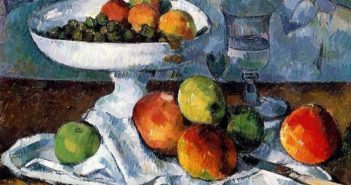
Letters paul-cezanne_still-life-with-compotier_
26

On the first day of art school in our first foundation class, our professor, a grey-bearded sage in brown corduroys, casually mentioned that Cézanne had already achieved everything in painting, so this was probably just a hopeless exercise. In terror, we squeezed out the assigned palette and studied a table of fruit in the middle of the room. In the library later, I checked what I was up against. “With an apple I will astonish Paris,” wrote Cézanne. For his innovation, his work was rejected seventeen times by the Paris Salon before a fellow artist intervened.

Letters diego-rivera_mural-2
15

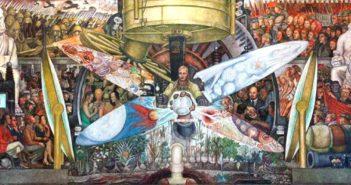
Painters sometimes run into problems when they attempt larger works. This goes for artists who transpose smalls into bigs, as well as those who make bigs for their own sake. For many, bigs and smalls can appear to be the work of separate artists. Spontaneity and simplicity in the small give way to complexity and labour in the large. In the larger painting we may be trying too hard or trying to “give too much.” Big paintings can fall into the “mish-mash” category — too much going on. Small paintings rarely have this problem.

Letters robert-bateman_mossy-branches-spotted-owl
7

On Saturday I was looking for something to paint when I noticed a commotion near at hand in the bush. A bear, I thought. Then the hook of a walking-cane stuck out. “What are you doing in there?” I asked. A man’s voice and then a man emerged. “Lookin’ fer an’ pickin’ chokecherries,” he said. He was a rough character, like an old cowboy in a baseball cap — he was wearing an old-fashioned galvanized iron apple-bucket with a canvas bottom. The cane was for getting at the high branches. “Try ’em,” he said, handing me a handful

Letters edgar-degas_place-de-la-concorde_1875
13

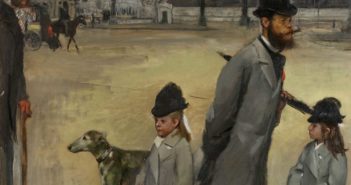
I recently returned from travelling to find a pile of mail gems, many from readers of these letters. One was a gift of a small paperback postmarked Crescent Pond, New Hampshire. I crawled into bed and into a list of timeless painting tips ordered by importance, the essentials highlighted and supported with first-hand insights from old and modern masters.

Letters robert-rauschenberg_cactus-kiss_1988
26

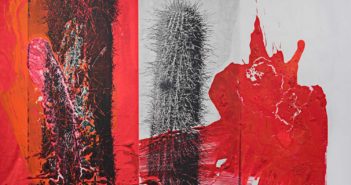
A subscriber wrote, “I used to evaluate paintings by looking at composition, technique, color, tone, texture, perspective, etc. Now I realize that even though these are important, they are really about craft and artisanship. I now think they come at a lower priority than the totality. I’ve rewritten my evaluation process: 30 points when the passing viewer comes to a stop. 30 points if viewer gets the point — message, feeling, mood. If too explicit, I deduct points. 35 points to artisanship as before. If, after a year, the viewer still enjoys looking at the painting, it’s worth another 5 points. Does this system make sense?

Letters sheila-hicks_embassy-of-chromatic-delegates
24

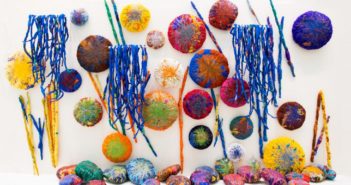
About halfway through the HBO documentary, “Becoming Warren Buffett,” a scene shows Warren Buffett and Bill Gates sitting at a table, each painting a picture — apparently a first for both. “He doesn’t know much about art,” says Bill in a voiceover. “I can’t tell you the colour of the walls in my bedroom or my living room,” says Warren. “I don’t have a mind that relates to the physical universe well.” For a moment, I thought I detected the slack-jawed bewilderment of a guy on the precipice of failure.

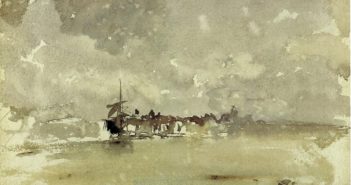
Letters whistler_gold-and-grey-the-sunny-shower-dordrecht-2
13

My experience has been that plein air requires a different mind-set than indoor work. Small inconveniences that do not occur in the studio can make or break the effort — a cool wind on the neck or a lightly primed canvas that lets the light through — minor irritants, but important to anticipate and prepare for. I recommend building up to the activity, finding comfort with your own methodology, not expecting too much. It’s the time-honoured “field sketch,” and it’s noble. Better to have a small diamond than a large piece of glass.

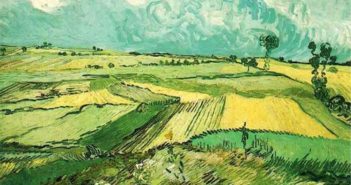
Letters van-gogh_wheat-fields-at-auvers-under-clouded-sky
15

At the National Gallery of Victoria here in Melbourne, throngs of sticky beaks move in mobs to inspect the largest collection of van Goghs to ever travel to Australia. The Seasons presents a four-sectioned survey of Vincent’s landscapes from the perspective of time of year — a pillar in his paintings and explored in his ebullient letters to his brother and best friend, Theo. Caressed by the Melbourne Symphony’s on-site Vivaldi and audio guide recordings of Vincent’s recited letters, visitors clog the galleries from open to close to channel his myth and scale, catching the Rhone breezes of Arles and taking selfies with a pair of satisfyingly on-style Cypresses.

1 17 18 19 20 21 271