Search Results: g (2707)

Letters louise-deweger4
43

My friend Sam emailed some work from her latest series. Before I knew it, I was writing back, “You need a show.” “I was going to contact you about that,” she replied. “Maybe you can help me a little bit with the foreign language of portfolios and galleries and what to do.” No problem, Sam. Here are a couple of time-tested ideas:
Letters john-singer-sargent_an-artist-in-his-studio
17

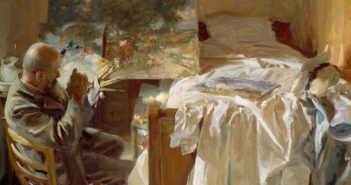
There’s a marvellous painting by John Singer Sargent called An Artist in his Studio. It shows a balding man in obviously reduced circumstances, his canvas half onto his mussed bed. He’s attempting to match colours from what appears to be a postcard.

The painting is bitter-sweet, and in a way, sad. By the window’s clean light, the old fellow is trying to get it right. It’s even sadder when we realize that these days “trying to get it right” is in danger of becoming a lost art. We are in the days of anything goes. Verisimilitude is often suspect, and many artists bend toward fashion

Letters basquiat_boneless
24

When travelling as a girl with my dad to workshops and demos, I noticed that he always brought a frame. At points throughout the painting process, he’d clip in the canvas and place it on a secondary easel, a few meters from where he’d set up. The idea was to get the composition stopped and distance the maker from his object. In this sliver of detachment, problems could be addressed, decisions made and the potential treasure imagined.

Letters henri-matisse_bathers-by-a-river
6

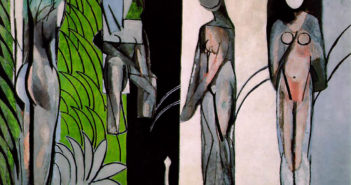
A subscriber wrote, “It has been pointed out that all of my paintings have a center of interest on the right-hand side. Generally there’s a dark blob on the right because that seems to be how I like to compose. Is this something to do with one side of the brain? Do other people have the same problem? Is it serious and in need of correction? I’m sure it occurs entirely unconsciously.”

Letters HongNian-Zhang_Return-of-Zhang-Qian
4

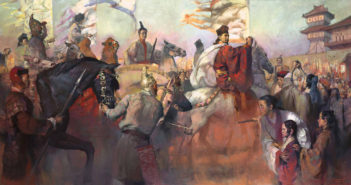
An old Chinese proverb says, “Do not grasp the brush before the spirit and the thoughts are concentrated.” This part of the creative process — the beginning part — needs to be handled with the same sort of attention as given to the later stroking. This is where you envision the potential; this is where you sort out the variables for the dish you are about to concoct. Why go for the same automatic cold rice, when almond gai-ding or egg foo-yong could be in the wok?

Letters charles-mingus3
18

On Monday evenings in New York City you can go to the Jazz Standard on 27th Street and hear the Mingus Big Band. Behind a plain metal door and at the bottom of a dark staircase is a space not much bigger than a suburban rumpus room, where fourteen specialized cats blast the organized chaos with free improvisation — tight, then loose, then tight again. The melodic storytelling is of the late jazz bassist and composer Charles Mingus.

Letters elaine-de-kooning
24

It’s a matter of getting an olive into your martini from across the bar. According to the handbook for “extreme bartending,” this sort of performance excites clients, alleviates boredom, speeds consumption, and sells liquor. Recently, while witnessing an example of extreme teriyaki, I was reaching for the wasabi when a flaming cleaver landed dangerously close to my hand. In any case, the next morning I had to have my suit dry-cleaned

Letters Robert-Genn_Mamalilicoola
39

A small painting was brought into a gallery under a woman’s arm. “My ex bought it at an estate auction,” she said. “It’s mine now, but I’d like to sell.” The dealer had represented the artist for many years, so was familiar with his paintings. Formerly, they came to him direct from the easel. More recently, they arrived once in a while, like this one — by way of custodians ready to pass along the provenance. To this dealer, the artist’s larches and firs, sky flicks and French greys had been burned onto the back of his eyelids. And the calligraphic name, laid-in lower right like clockwork, was the signature move

Letters roloff-beny
13

I used to know a photographer by the name of Roloff Beny. Roloff was responsible for a dozen big-format coffee table books. Persia, Bridge of Turquoise was well known, as well as his famous To Every Thing There is a Season. Roloff picked an area and went through it thoroughly. A friend of the Shah of Iran, he once took a red-carpeted year to travel that country in his Land Rover. Roloff generally arose before dawn and was already set up at first light. The midday sun found him asleep in the FWD. I never did figure out where or when his faithful driver slept. As evening and the “magic hour” approached, Roloff was back on the job. “As an artist you should be in business until the time when you almost can’t see,” he used to say. A few years ago he met an untimely end in his bathtub in Rome

Letters Winslow-Homer_Boys-in-a-Pasture
33

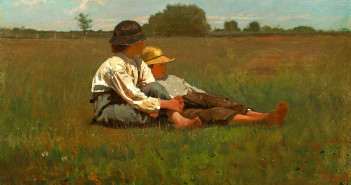
A subscriber wrote, “I know by experience that art-making is a conduit to something higher than workaday life — but I’m finding it harder and harder to overcome depression about the low status of my day job and the low status of visual artists. It’s not just that painters are viewed with some contempt; increasingly, our work just isn’t viewed at all. Look at the entertainment section of any newspaper. It will have articles on just about every other art form but painting. It seems that painting is terminally ill or dead. At age 42, I have the typical dream

1 23 24 25 26 27 271