Search Results: m (2712)

Letters helen-frankenthaler_basin
16

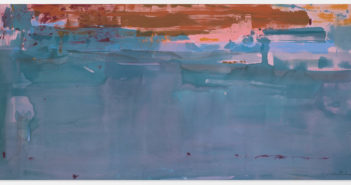
“To be put in any category not defined by one’s work is to be falsified,” said Elaine de Kooning, responding in 1971 to being characterized as a “woman artist.” She was pushing back against a new field of art history which was burgeoning on the sidelines of the contemporary art world called, “feminist art theory.” She wanted to be judged not by gender but solely on her ideas and skill.
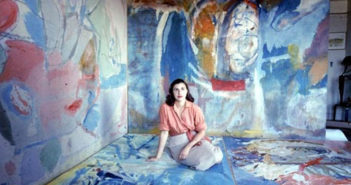
Letters helen-frankenthaler_in-her-studio
32

Recently, an aspiring screenwriter friend told me she’d quit her day job. “I tried to just reduce my hours, but they kept creeping back to full time,” she said. “It was really hard to let go. I realized I was afraid of losing something I might never get back, instead of facing forward and going for what I truly wanted, which is to be a writer.” We agreed that committing ample space for a creative venture is a common barrier for would-be pros. “If I don’t go for it now, I’ll never know,” she said. We made a toast to the extravagant void in front of her.

Letters cartier-bresson_5
10

In 2004, at home in the south of France, Henri Cartier-Bresson, one of the world’s best-known photographers, died. He was 95.

“One eye looks within, the other eye looks without,” said Cartier-Bresson. Starting with the simplest of box cameras, most of his life he worked in black and white with a quiet Leica, without a flash. He didn’t believe in cropping, staging, tricky developing or dodgy printing. His business was trapping the momentary visual delights of life in motion. “For me, the camera is a sketchbook

Letters Judith-Leyster_self-portrait_ca.1630
36

A recent study conducted by German neuroscientists scanned the brains of artists to try to figure out why so many of us are broke. When presenting subjects with a button that delivered a cash reward when pushed, researchers noticed that artists’ brain activity flatlined when compared to dentists and insurance agents. MRIs and dopamine measurements showed artists to have a reduced activation in the brain’s reward system. On top of this, a second test showed the artists were having a heightened response in another area of the brain. When told they could reject the cash prize, dopamine surged. Renouncing money, it seemed, is what got artists fired up.

Letters edgar-whitney_la-carriere
16

Why do some achieve mastery and others not? How is it that some “get good” and others never seem to? For many of us who teach or practice art — this is a question that we ask every day — about others and about ourselves. With all the interest in formal art education, workshops, self-promotion, sales, and other secondary art activities, there is, after all, no greater value than simply becoming a “master.” How does this happen? In my experience it largely occurs when the artist is alone. It’s a function of individual character.

Letters saraincontraluz-hornbyisland-bc-20x24-Robert_Genn
24

A subscriber wrote, “I fear I lack what’s required to be a great artist. My work seems to blend in with the work of others, I have trouble putting myself forward and I’m plagued with self-doubt. Am I just lacking the ego to do it properly?”

Thanks. You’re not lacking ego — everyone has one. You may have merely misplaced your ego’s good stuff while mistaking its darker qualities for the absence of one.

Letters onley-lodi-tombs_big
2

Not everyone knows what I’m talking about when I drag the word “homeomorphic” out in mixed company. Specifically to do with equality of shapes in differing chemicals, it’s not in the art books. But it’s a valuable creative concept. Without always knowing its name, homeomorphism is generally pointed out as a type of compositional problem. Typically in amateur work, it’s a lineup of equidistant trees, or a mountain that rises up conveniently in order to avoid colliding with a foreground element. It’s a natural tendency of the human mind to automatically organize things neatly and in a regular manner.

Letters Corot_Young-Girl-Readingt_c1868
4

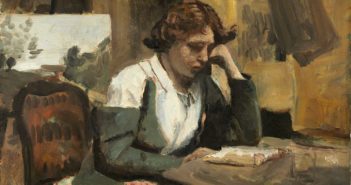
Perhaps it’s the unsettling variety or the mind-bending sunshine. I’m at sixes and sevens and my stuff is all over the place. Maybe it’s just being away from the home studio. Maybe I’m coming up on another period. Last night, with the lazy fan turning and the wall-geckos chirping, I was dreaming of Corot.

Letters a-j-casson_madawaska-valley
33

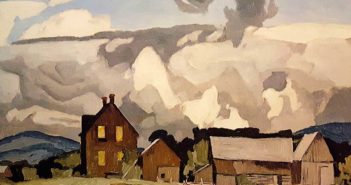
Artist Damien Hirst, describing his spot paintings made by offsite assistants at undisclosed locations, said, “They’re all a mechanical way to avoid the actual guy in a room, myself, with a blank canvas.” For Hirst, it was a way of avoiding the possibility of his own mediocrity.

Weekly, an email comes in describing similar avoidance. They usually have an elaborate end-goal in mind, but struggle, for years sometimes, to get into the activity that the goal requires. What’s the matter? The matter is fear, and fear breeds avoidance.

1 13 14 15 16 17 272